The Enigmatic Beauty of the African Hairy Bush Viper
Post By: @DrewWild
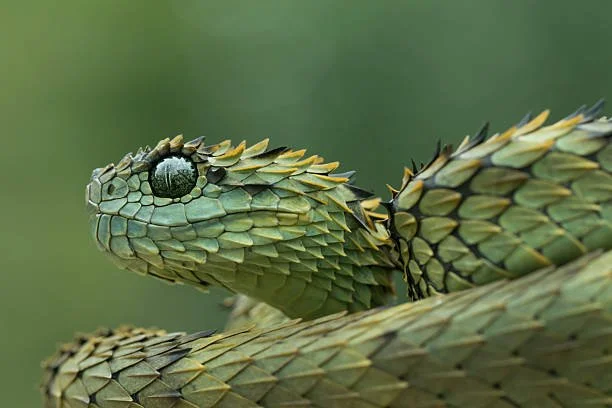
Image © Mark Kostich
Hidden deep within the rainforests of Central Africa lives one of nature’s most mesmerizing reptiles. The African Hairy Bush Viper (Atheris hispida). With its striking, almost mythical appearance, this small but formidable viper captures the imagination of herpetologists and wildlife enthusiasts alike.
The “hairy” in its name comes from the snake’s highly keeled, bristle-like scales that give it a rough, spiky texture. These scales catch the light in fascinating ways, creating a shimmering illusion that looks almost feathery. Typically, the snake’s coloration ranges from vivid green and yellow to deep bronze or even bluish hues, blending seamlessly with the mossy foliage of its forest home.
Native to the forested regions of Central and East Africa, the Hairy Bush Viper thrives in dense, humid environments. It is most often found in the Democratic Republic of Congo, Uganda, Kenya, and Tanzania, where it spends much of its life in the trees. This arboreal lifestyle allows it to hunt and move stealthily among the branches, rarely descending to the forest floor.
Despite its fearsome appearance, the African Hairy Bush Viper is a small snake, usually measuring between 18 and 24 inches (45–60 cm). It’s a nocturnal ambush predator, relying on camouflage and patience rather than speed. Its diet consists mainly of frogs, small rodents, lizards, and occasionally birds, anything it can catch and overpower with its potent hemotoxic venom.
The venom of Atheris hispida is dangerous, though bites are extremely rare due to its remote habitat and reclusive behavior. The toxin affects blood and tissue, typical of viper venom, but detailed medical studies are scarce because encounters are uncommon. Its fearsome look and mysterious nature have earned it a place in local folklore, where it’s sometimes seen as both a guardian of the forest and a symbol of danger.
Few animals embody the wild beauty of Africa’s rainforests as perfectly as the Hairy Bush Viper. With its intricate scales, piercing eyes, and deliberate movements, it looks more like a creature from a fantasy world than a real reptile. Yet, it serves as a reminder of how diverse and delicate our planet’s ecosystems truly are.
The African Hairy Bush Viper is more than a stunning reptile but it’s a symbol of mystery, adaptation, and survival in one of the world’s richest and least explored habitats. Protecting such species means preserving not only their beauty but the fragile web of life that sustains them.