Let's go into detail on snake venom in the medical field!
Post By: @DrewWild
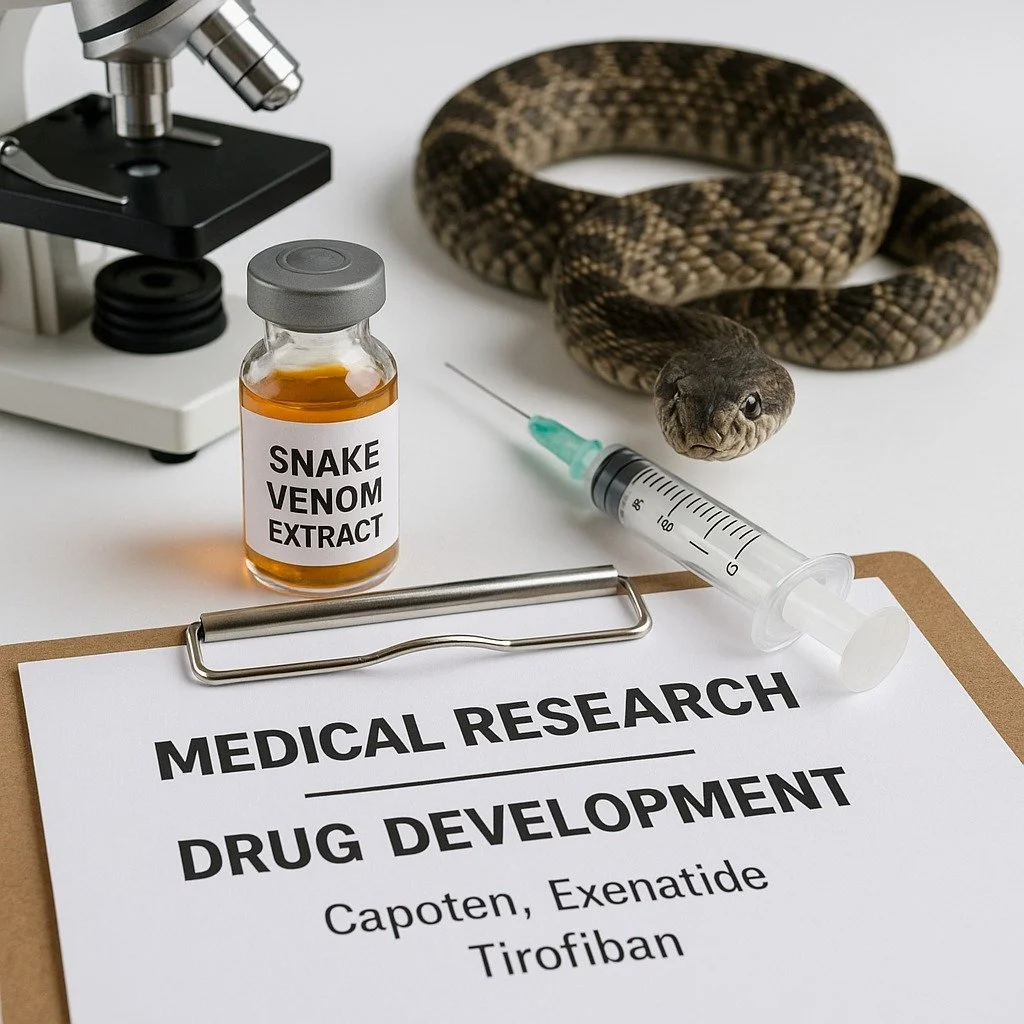
1. Captopril (Capoten)
-Use: Treats high blood pressure and heart failure.
-Source: Brazilian pit viper (Bothrops jararaca).
-How it works: Inhibits angiotensin-converting enzyme (ACE), lowering blood pressure.
-Fun fact: This was the first successful drug developed from snake venom, paving the way for ACE inhibitors.
2. Eptifibatide (Integrilin)
-Use: Prevents blood clots during heart procedures like angioplasty.
-Source: Southeastern pygmy rattlesnake (Sistrurus miliarius barbouri).
-How it works: Blocks platelet aggregation by targeting glycoprotein IIb/IIIa receptors.
3. Tirofiban (Aggrastat)
-Use: Also used to prevent blood clots in patients with acute coronary syndrome.
-Source: Inspired by venom of the saw-scaled viper (Echis carinatus).
-How it works: Similar to eptifibatide prevents platelets from sticking together.
4. Batroxobin
-Use: Used in diagnostic tests and occasionally to treat blood clotting disorders.
-Source: Bothrops atrox venom.
-How it works: Promotes clotting by acting directly on fibrinogen, unlike thrombin.
5. Ancrod
-Use: Investigated for use in stroke treatment (now largely discontinued).
-Source: Malayan pit viper (Calloselasma rhodostoma).
-How it works: Breaks down fibrinogen, reducing the risk of clot formation.
6. Other Venom‑Derived Biotherapeutics (Non-Snake or Broader Venom Sources)
Although not from snake venom, these merit inclusion for context they’re from other venomous animals:
-Exenatide (Byetta®, Bydureon®): GLP‑1 receptor agonist derived from Gila monster (Heloderma suspectum) venom; used to treat type 2 diabetes mellitus
-Ziconotide (Prialt®): From a cone snail (Conus magus) approved for severe chronic pain, delivered intrathecally
7. Leech‑derived thrombin inhibitors:
-Bivalirudin (Angiomax®), Lepirudin (Refludan®), Desirudin (Iprivask®): used for anticoagulation, derived from medicinal leech venom; not snake but relevant in the same venom‑based therapeutics category.
8. Emerging experimental drugs derived from snake venom
-Mambalgins – Non-Opioid Painkillers
-Source: Black mamba (Dendroaspis polylepis)
-Target: Acid-sensing ion channels (ASICs) in the nervous system
-Effect: Strong analgesic effect without respiratory depression, addiction, or tolerance
-Status: Preclinical; identified in 2012 (Inserm, France); ongoing work to develop synthetic or modified analogs
-Potential use: Chronic pain, cancer pain, post-surgical pain
-A highly anticipated alternative to opioids.
9. Contortrostatin – Anti-Metastatic & Anti-Angiogenic
Source: Agkistrodon contortrix contortrix (southern copperhead)
-Type: Disintegrin (protein that binds integrins on cell surfaces)
-Effect: Inhibits tumor cell adhesion, migration, angiogenesis, and metastasis
-Preclinical success: Suppressed breast cancer metastasis in mice (MD Anderson research)
-Delivery strategy: Liposomal formulations to improve stability and targeting
-Not cytotoxic blocks spread rather than kills cells so it’s less harsh than chemo.
10. Salmosin – Tumor Angiogenesis Blocker
Source: Agkistrodon halys brevicaudus (Korean viper)
-Type: Disintegrin peptide
-Effect: Binds integrin on endothelial cells inhibits blood vessel formation (anti-angiogenic)
-Cancer models: Inhibited melanoma and glioma progression in mice
-Status: Experimental; explored for glioblastoma and other solid tumors
11. Echistatin & Derivatives – Integrin Blockers
-Source: Echis carinatus (saw-scaled viper)
-Target: Integrins involved in tumor growth, angiogenesis, and metastasis
-Variants: Used to create synthetic analogs for better pharmacokinetics
-Current role: Used as molecular scaffolds in cancer and cardiovascular research
12. Crotoxin – Dual Role in Pain and Cancer
-Source: Crotalus durissus terrificus (South American rattlesnake)
-Components: Phospholipase A2 + crotapotin (a stabilizing protein)
Effects:
Neurotoxic at high doses
-Immunomodulatory and anti-inflammatory at low doses
-Shown to suppress tumors and pain responses in animal models
-Potential: Adjuvant in cancer therapy, autoimmune diseases
-Status: Preclinical/experimental
13. Cardiotoxin (CTX) – Cancer Cell Apoptosis Induction
-Source: Naja naja atra (Chinese cobra)
-Effect: Induces apoptosis in liver, breast, and leukemia cells via mitochondrial pathways
-Challenge: High toxicity needs targeting or nanoformulations
-Research direction: Encapsulation in liposomes or antibodies for tumor selectivity
14. Snake Venom–Derived Nanoparticles
-Concept: Using venom peptides (like disintegrins or PLA2s) to coat or load nanoparticles that selectively bind to cancer cells
Goals:
-Reduce off-target effects
-Increase bioavailability
-Deliver drugs directly to tumor vasculature
-In progress: Multiple labs are investigating conjugates of venom peptides with gold nanoparticles or liposomes
15. Neurotoxins as Autoimmune/Neurological Modulators
-Venoms from elapids (e.g., cobras, kraits, mambas) contain α- and β-neurotoxins that interact with:
-Nicotinic acetylcholine receptors
-Sodium and potassium ion channels
Emerging uses:
-Treating multiple sclerosis, Alzheimer’s, or Parkinson’s via neuroprotective pathways
-Blocking autoimmune inflammation (very early research)